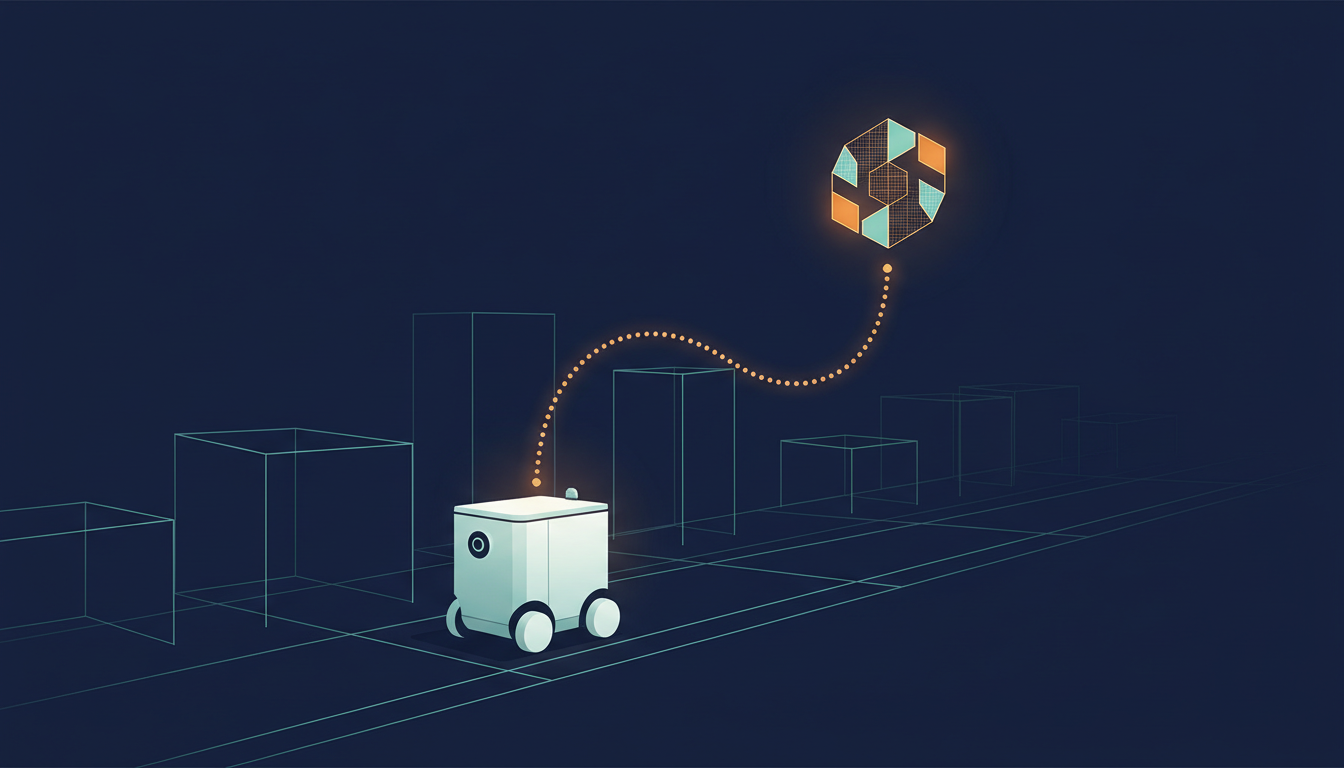
Your AI Agent Can Now Order a Real Robot Onto the Sidewalk
Most agentic AI demos stay inside the browser. The agent books a meeting, drafts an email, reorganizes a docs pile. Serve Robotics just opened something with more weight behind it: a production API where the output of a function call is a physical machine rolling down a sidewalk with someone’s lunch inside.
On November 11, Serve launched its AV Delivery Developer Portal to outside developers. The company operates 2,000 delivery robots across more than 150 neighborhoods in 20 US cities, and the fleet has completed hundreds of thousands of deliveries. Until now, that capacity mostly moved orders for Uber Eats and a short list of partners. Any app can request a delivery now, and Serve states plainly that AI agents count as callers. An agent can book a robot the same way it calls a weather API.
If you build agents, this is one of the first production-grade bridges between an agent’s decision and a machine in the physical world. It is also a good excuse to talk about what actually breaks when software meets a fleet.
What the API does
The workflow is three calls: quote, job, track.
Quote. Your app or agent sends pickup and dropoff locations, and gets back a price and ETA. The quote expires in five minutes and reserves nothing — more on that below.
Job. Accept the quote and Serve dispatches a robot from an available zone.
Track. Follow the job status to completion. Serve handles dispatch, routing, street-level navigation, and remote human supervision when a robot gets confused.
A sandbox with simulated robots lets you build the entire integration without being in a Serve city. Live access beyond the sandbox requires Serve’s approval, and live deliveries stay within active service zones and cargo limits. So a developer on another continent can prototype the full flow today and apply for live access when deployment gets real.
None of that is unusual for a logistics API. The interesting parts sit at the edges.
The failure states are the real spec
Two behaviors in the API matter more than anything in the announcement copy.
Quotes expire after five minutes and reserve nothing. The quote is an offer you have to redeem fast, and if your checkout flow takes six minutes between quoting and job creation — payment review, fraud checks, a human approving something — the quote dies and you start over.
Requests also fail outright when no courier is available or the address is out of range. An order can clear your checkout and then fail at dispatch. Every serious integration needs a fallback plan for that gap: a human courier option, an automatic refund path, a retry queue with honest customer messaging. This is the unglamorous half of the work, and it is the half that decides whether the integration survives.
There is a third edge specific to agents. An autonomous caller will eventually hit the case where the quote succeeded, the job failed, and the customer already received a confirmation. Code review for agent integrations should treat that sequence as inevitable rather than exceptional. Write the recovery path first, then write the happy path.
Why agents as first-class callers matters
Every API is technically callable by anything that can send HTTPS. The difference here is intent. Serve designed the portal so that an AI agent booking a delivery is a supported, rated, normal use case rather than a terms-of-service gray zone.
That changes the architecture conversation. A concierge agent for a hotel could arrange a robot delivery of forgotten medication. A field-service dispatch agent could route a spare part across a campus. None of these need a human in the loop between intent and dispatch, because the API contract assumes the caller might be software with authority.
The honest caveat: volume economics are undisclosed. Serve has not published per-job pricing tiers or the unit economics of a delivery at scale, so anyone building a business on this API is negotiating in the dark on margin. Prototype freely, but read the commercial terms carefully before promising customers a price.
The context behind the launch
The API is not a victory lap. It is a diversification play under real pressure.
Serve said in August that it expects its Uber Eats deal not to renew in early 2027, and Uber has sold its entire stake. Losing your anchor customer concentrates the mind. The numbers suggest the pivot started working before the API even launched: in Q3, daily delivery volume among new platform partners tripled. On November 5, Serve also launched Physical AI Services, selling its software stack and sidewalk navigation data to other robot makers.
Put together, the company is trying to become infrastructure — the dispatch layer and the data layer for sidewalk robots generally, well beyond running a fleet for one food app. Whether that pays depends on adoption, and the undisclosed per-job economics are the number to watch in future earnings calls.
What to do now
- Request sandbox access at the AV Delivery Developer Portal. It costs nothing and needs no live city.
- Build the dummy order flow end to end: quote, wait, job, track. Use the simulated fleet. Time each step.
- Deliberately break it. Let a quote expire. Send an out-of-range dropoff. Send a job when no courier is available. Log every failure shape your code receives, because those responses are your real integration spec.
- Design the fallback before the polish. Decide now what happens when dispatch fails after payment: refund automation, courier backup, or a support ticket with honest timing.
- If you build agents, wrap the API in a tool that exposes the failure states as first-class outcomes, not exceptions. The agent should reason about “no robot available” the same way it reasons about “out of stock.”
The interesting software of the next few years gets built at exactly this seam, where an agent’s conclusion turns into a physical action someone can film. A robot carrying pad thai because a language model decided it should is a modest start. The pattern behind it, APIs that treat agents as legitimate operators in the physical world, is worth prototyping before your competitors do.
Source: Serve Robotics investor announcement, November 11, 2026; Q3 2026 earnings commentary.