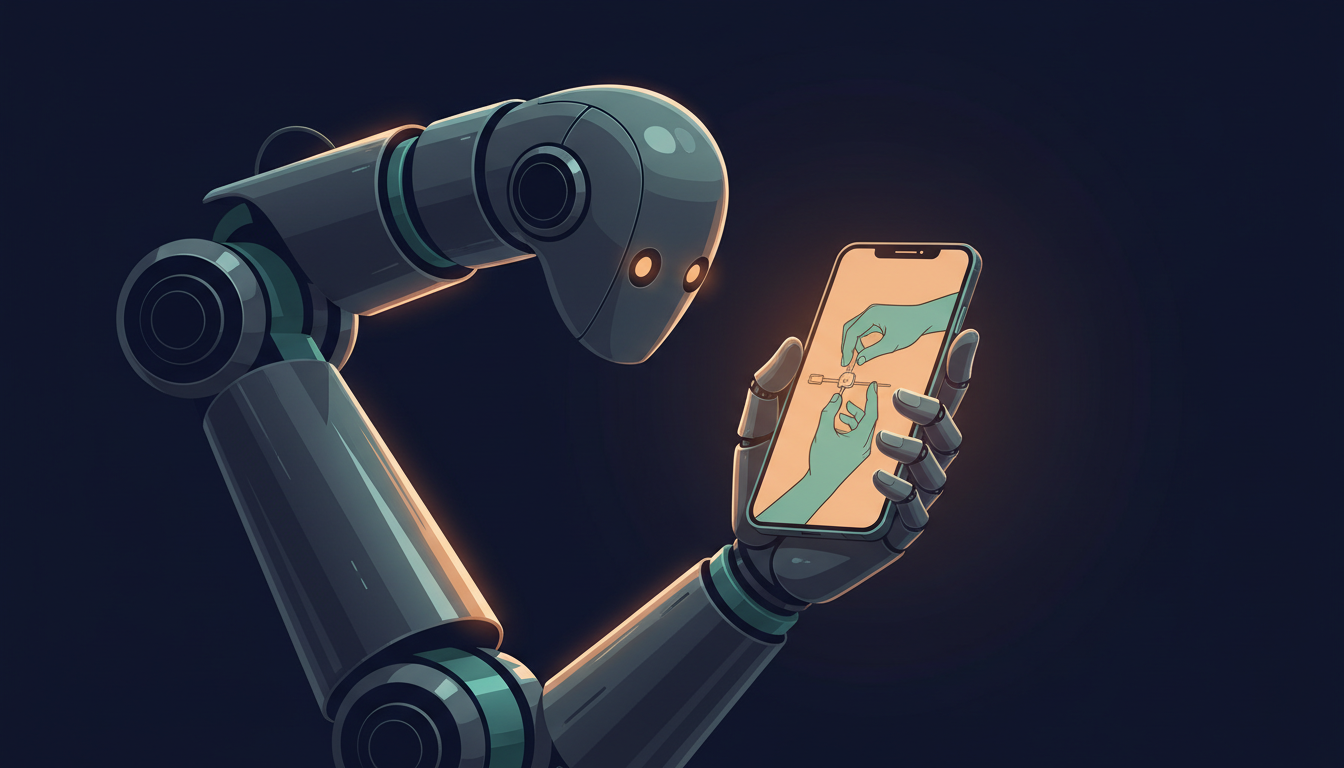
One Video Is the New Robot Training Manual
Robots that learn a new job from a single video are here, and the economics of automation just changed with them.
Skild AI published results for S1, its general-purpose robot manipulation model, and buried in the announcement is a number that should worry anyone selling fine-tuning services: on tasks the robot had never seen, video prompting beat language prompting by 7x. Not 7%. Seven times.
The comparison matters because it marks the line between two eras of robotics. Since the field began, teaching a robot a new task meant demonstration data collected on the exact hardware, in conditions matching deployment — teleoperation sessions, motion capture, hundreds of hours of it. Skild’s own framing is that robotics has been stuck in its “BERT era,” and if you watched language models go from task-specific fine-tuning to simply talking to GPT-3, you know how that story goes.
What S1 actually does
Show S1 a single video of a task, and it executes that task with the same frozen weights it had before. No fine-tuning, no post-training, no robot engineer in the loop. The demo in the video can be up to 10 minutes long, and it doesn’t have to match the robot’s world: different scene, different camera angle, even a different body doing the demonstrating. The model has to infer what the demonstrator was trying to accomplish, then translate that intent to its own hardware.
The tasks Skild showed are the telling part. Plant potting. Cooking pancakes. Pour-over coffee. Kit assembly. None of them appeared in the training data. Each spans dozens of manipulation steps, and all of it is driven by one visual prompt.
If you’ve used GPT-3-style in-context learning, this is the same idea with a robot at the end of it. Prior research had shown an awkward fact: with enough task-specific data, policies trained from scratch could match post-trained foundation models, which made pre-training look optional. Skild’s answer is that pre-training exists to buy in-context learning. S1 was trained on episodic data where tasks were specified only through demonstration in context, forcing the model to learn intent rather than memorize tasks.
Why the 7x number is the story
Language prompting and video prompting both work on S1 — the gains are real in both cases. But on in-distribution tasks, ones the model had seen during training, video adds only moderate improvement. The 7x jump only shows up out of distribution.
That asymmetry is what separates a demo from a capability. Anyone can train a robot on a task and then show the robot doing the task. The expensive problem has always been the hundredth task, the one nobody collected data for. If one video closes that gap, the marginal cost of a new robot task drops from an engineering project to a YouTube clip.
It’s also, quietly, a data strategy. Teleoperation data is closest to the hardware but scales worst. Egocentric video from humans is everywhere but has the biggest domain gap. Skild says it scales all sources at once, and S1 is already deployed with commercial partners, trained on NVIDIA infrastructure.
What this does to automation economics
Say you run a warehouse or a commercial kitchen and you’ve priced robotic automation in the last two years. You probably saw line items like these:
- Tens to hundreds of hours of demonstration data collected per new task
- A fine-tuning cycle per robot model, repeated when hardware changes
- Integration work that quietly doubled the first-year cost
- A specialist vendor relationship for every task added after launch
Now compare that with: one person records one video of the task being done by hand, and the robot runs it. The task-onboarding cost collapses toward the cost of the video. When that happens, the constraint on automation stops being data collection and becomes the same old things it always was: safety certification, throughput, and whether the robot can physically do the work.
Competing work has not caught up. Generalist’s Gen 1.5 and RoboTTT, the closest comparable results, remain limited to short-horizon tasks or tasks inside their training distribution. Skild builds on its own LocoFormer locomotion work from September 2025; the first in-domain in-context results arrived in February 2026 and the first pancake flip in May. The distance between “first pancake flip” and “unseen 10-minute multi-step tasks from one video” was four months.
What to do now
If you buy or specify automation, three moves are worth making this quarter.
First, stop paying for demonstration data as a default line item. Any vendor still quoting 100-hour data collection per task should be asked why, in writing, and made to show what happens when you hand them a video instead. Some will have good answers — safety-critical tasks, high-precision assembly — but the burden of proof has moved.
Second, re-run your automation ROI models with task-onboarding cost near zero. The tasks that were marginal last year because onboarding ate the payback are the ones to look at first. Anything repetitive, multi-step, and currently staffed by people who hate doing it is a candidate for a fresh spreadsheet.
Third, if you’re on the vendor side, figure out your answer to “why do you need my data?” before the question arrives. The answer is no longer obvious, and buyers who read one Skild blog post will know it.
The caveat worth keeping in mind: these are Skild’s numbers, on Skild’s benchmarks, published by a company raising money and signing commercial partners. The 7x figure is on out-of-distribution tasks in their evaluation, not an independent audit. Treat it as a strong signal of where the field is going, not a procurement-grade guarantee. The direction is clear enough that planning around it costs less than ignoring it.
Robots spent decades waiting for someone to show them what to do, one painful demonstration at a time. The waiting may be over. If a robot can learn pour-over coffee from a clip somebody filmed on a phone, the scarce resource in automation is no longer data. It’s knowing which tasks are worth automating in the first place.
