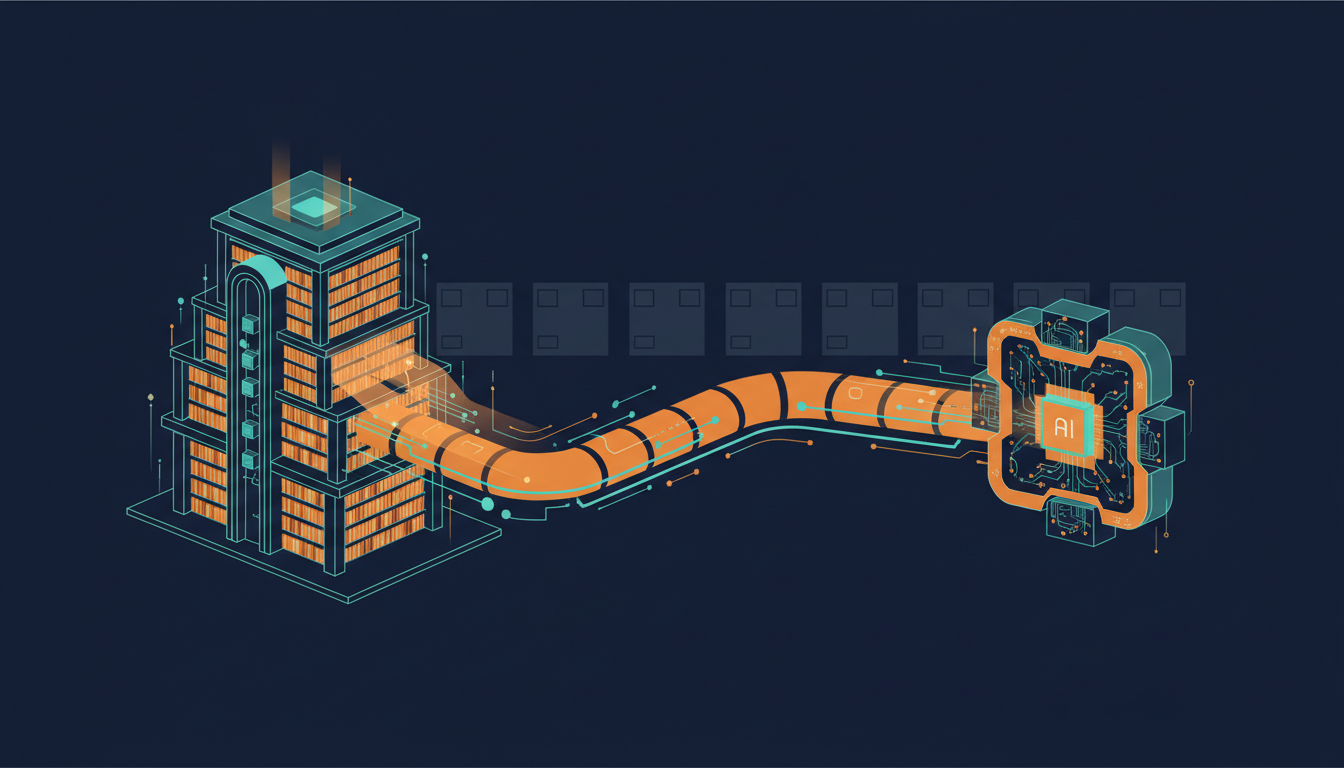
Joel Hron, CTO of Thomson Reuters, describes the usual approach to enterprise AI in a way that stings if you run a content business: renting AI is like renting a house. You pay every month and at the end you own nothing. His company just showed what buying looks like — two years, $40 million, and a legal AI model built on Alibaba’s open-weights Qwen, trained on decades of Westlaw and Reuters content.
The $40 million is the headline number. The one that matters more is $450,000. That was the cost of the latest full training run. The expensive parts — the team, the infrastructure, the data pipeline — are already paid for. Every improvement cycle from here costs a fraction of the initial build, and the model keeps absorbing a corpus nobody else can legally train on.
The details were reported by The Rundown AI and Business Insider, and they’re worth sitting with if your business produces or depends on specialized content.
What Thomson Reuters actually built
The company took Qwen, Alibaba’s open-source foundation model, and retrained it on its own library: the legal materials behind Westlaw plus the Reuters newswire archive. The results so far are internal — benchmarks that put the model ahead of Claude Opus 4.8, Gemini 3.1 Pro, and GPT-5.5 in certain areas. External validation hasn’t happened, and the company is careful not to overclaim. An open-weights version is planned so researchers can examine it.
My favorite detail in the whole story: training so far has consumed under 10% of the content library. They built a model that already competes near the frontier, and they haven’t finished the first lap through their own data. Whatever this model becomes, it gets better from here almost by default.
Why this became possible now
Two years ago, “we’ll build our own model” meant training from scratch — reserved GPU clusters, a research team, a bill with eight or nine digits. What changed is the foundation layer. Qwen is free to download, competitive with closed models on many tasks, and licensed for commercial fine-tuning. This week IBM shipped its Granite 4.2 family under Apache 2.0, with reasoning modes, a 512K context window, and agentic training baked in.
The base model has become a commodity. The scarce input is proprietary data, and that’s the one thing content companies already have sitting in storage.
The math most companies never run
Nobody enjoys reading another build-versus-buy framework, so here is just the question: what did your company spend on AI APIs and seats last year? Project that over three years. Then ask what you own at the end of it.
For a company with thousands of knowledge workers running frontier models at volume, that three-year projection gets uncomfortable fast. The spend recurs, and it doesn’t compound into anything. Hron’s framing is exactly right: rent leaves you with no equity.
Thomson Reuters’ $40 million bought three assets. A model tuned to their domain. The team that built it. The infrastructure to keep improving it. The next training run is a $450k line item, not a moonshot, and each run converts more of their existing content into model capability. That’s the compounding the API invoice never gives you.
Who this playbook is actually for
Honesty time: this is not for everyone. Thomson Reuters has three things most companies lack. A deep, structured, rights-cleared corpus built over decades. The engineering capacity to train and maintain models. And customers who already pay premium prices for exactly that content. Remove any one of those and the spreadsheet falls apart.
The first wave of copycats is predictable: medical reference publishers, financial data providers, other legal publishers. Anywhere the archive itself is the moat. Media companies with long-running specialized archives, like trade press and curated libraries, are the next ring out. If your content is undifferentiated or your corpus is thin, stay a renter. The API is honestly the better deal for you.
What to do now
You don’t need $40 million to start testing the thesis.
- Audit your corpus. Do you actually have content that general models perform badly without? Be brutal about it — is it deep, structured, and yours to train on?
- Measure AI spend per workflow. Cost per outcome, not per seat. You can’t evaluate rent versus own without knowing the rent.
- Pilot one workflow on open weights. Fine-tune Qwen, Llama, or Granite on a single high-value task and benchmark it blind against your current API stack. A scoped pilot is a rounding error next to $450k.
- Build domain evals first. Thomson Reuters’ “beats GPT-5.5 in certain areas” is an internal claim. Your own benchmarks will also flatter you unless you design them not to.
The caveats worth keeping in view
Two years is a long time to wait for a model, and the whole bet rests on internal benchmarks until the open-weights release lets outsiders poke at it. “In certain areas” is doing real work in that sentence, and everyone quoting it should slow down before declaring the frontier beaten.
The direction is still set, though. The company with arguably the most valuable proprietary corpus in legal publishing ran the numbers and decided the API route was the expensive option. If you’re sitting on an archive, run the spreadsheet. Even if you stay a renter, you’ll negotiate the lease better knowing what the alternative costs.
Based on reporting by The Rundown AI and Business Insider, August 26, 2026.